Wednesday, October 10, 2018

Moorish Spain and Tiles Tiles Everywhere


So I came back to Spain for the second time this year. I hadn’t intended to come back so soon, actually. It was merely by association. I had asked for three weeks off in October to travel (Thanks, Scott!), but in my uninspired procrastinating ways I hadn’t made any plans until a few weeks ago. My pattern of taking trips during shoulder seasons in either April or October usually limits me to areas of good weather during this time. So, I had decided on Morocco, a place that I have always wanted to see but years ago I was too cheap to fly to. And since I made up my mind to go to North Africa, it was always on my mind to lump in this special southern region of Spain. I had heard so much about places like Seville and Granada. And so I thought, why not spend a few more weeks to burn through my Spanish textbook again over more tapas. Or perhaps, forget about the Spanish textbook.


So far I’ve been to Madrid, Barcelona, and part of the north in Bilbao and the beautiful San Sebastian. But the southern region of Spain, called Andalucia, is quite unique in its own historical beauty (I had no clue this region was called that, as I walked stupidly past this guidebook in Chapters numerous time asking the clerk for a book on “Southern Spain…”). Andalucia is in reference the the old Moorish name of the region, and the Moors refer to the dominating Islamic Berber group who came from North African and conquered wide stretches of Europe and most of Spain. In fact, many of the southern parts had over 500 years of Moorish rule dating back to the 700s BC, and in the last glorious stronghold, Granada, had almost 800 years of rule. The region was steeped in history over several significant ruling dynasties. The first were the Romans (many claimed that Julius Caesar had started Seville, as a statue of his stands prominently at a public plaza). After them came the Visigoths from the north who apparently did nothing. The Moorish were the main lasting influence to this region, introducing strong architectural wonders, city planning, culture, and culinary pleasures. After the Moors came the Christians in their “reconquista”, who chose to cleanse the region of Islamic influence and seemingly lazily added Christian elements to stunningly built Islamic mosques to make them cathedrals instead. This last part was responsible of some of the most unique and beautiful landmarks of the region. This area was also key in dark times such as the Spanish Inquisition, served as at the starting point of Christopher Columbus “discovery” journey, and blossomed in an era of golden trade after the discovery of America when merchant ships returned with their exotic produces. It is also regarded as the epicenter of the Spanish tradition of Bull-fighting, with some of the most famous arenas around. And further south, in line with the Spanish devotion to the indulgences of life, home to the famous “Sherry triangle” from where the popular drink was born. 


The big brother of the region would inevitably be Seville, or Sevilla, depending on how you like to say it. Once one of the largest city in Europe due to being the only gateway of American goods, its golden age ended when the trading posts were moved further South to Cadiz. It was for a while a Moorish capital after Cordoba, and still home to spectacular pieces such as the Cathedral (the largest one of its type) and the exquisitely beautiful interior of the Alcazar (don’t miss this, and get tickets in advance online to beat the line-up). Nearby and about 45 minutes away on the high speed AVE train stood Cordoba, the long standing old Moorish capital and home to the unique red-and-white brick interior of the Mezquita, prominently featured on the cover of my Rough Guide Andalucia guidebook. It’s close enough for a daytrip from either Seville or Granada, and it would be more charming had it not been for the flocks of tourists, many of them yielding their selfie sticks shamelessly and standing right in front of the shots you are trying to take, oblivious to their mean ways. 


But the undisputed masterpiece of the region, without a doubt, is Granada, beautifully situated next the the Sierra Nevada mountain range, and home to the stunningly beautiful Alhambra, a former moorish palace/fortress kept standing owing to years of self preservation by the last remaining moorish kingdom by paying off the surrounding Christian ruler (or something of the sort), but eventually falling in 1492. Be warned, however, that you MUST get online tickets, preferably MONTHS in advance, or risk not being able to go to the most precious parts (currently, the only two other ways are to either get a Granada card, also scarce, or join a tour, as lining up in the morning is no longer an option.) I, of course, did not plan that well, and freaked when I discovered the case (it was sold out all the way into January). Luckily, after a series of repeated clicking, I managed to nail down a 7pm ticket, but required me to revise my travel plans (happy to). The hassle was worth the effort. Inside, all the thoughtful and intricate details of the pinnacle of moorish architecture was on full display. Please ensure you bring a spare battery, for with every turn of the head there are careful details requiring your documentation. The most outstanding display is inside the Nasrid Palace, as almost every inch of stone inside and out is carved in exquisite details. And just when you stare in awe thinking you have already witnessed the main event, you are led to another room of jaw-dropping displays which happily out-does the previous room. You can easily spend hours here, and most of us had to be literally kicked out at closing. Outside the fort, central old town Granada can be a little too touristy and hippy-ish (think narrow corridors of the Stanley Market in Hong Kong). But if you venture a little further, or like me, rented a scooter to beat some of the humbling climbs of the steep narrow streets, you can be rewarded. Perhaps the best way to do the city, in my opinion.


Down south about an hour and a half away, starting in Malaga, is the famous Costa Del Sol, a dense overdeveloped Sunshine belt drawing hundreds of European vacationers every year (although, from what I’ve read as I actually didn’t get to see it, it really isn’t all that beautiful but instead just hyped up marketing). Instead, I rented a car and took my time driving an alternative route, through a little hot spring town called Alhama de Granada, then cutting right through the Sierra de Tejeda in what seems like a vertical split of the mountain ranges at Zafarraya Pass. Along the Mediterranean coast, most of it were simply uninspired sleepy retirement-like towns developed to attract European tourists. But once you roll into Malaga, you are once again reminded of the deep history of this region, and the dynamic youthfulness that seems to blend perfectly with it. On a side note, driving in the city of Spain is a nerve-wrecking experience, even for someone who loves to drive. Perhaps the most terrifying part, was trying to squeeze my rental car up SUPER steep narrow ramps in a parking lot in the old town. I stalled twice, and had a slight moment of panic as I thought the car simply did not have enough power to climb up. I now look at all European drivers with much admiration. Even the ones who almost run me over many times.


And then there are the numerous pueblos blancos, or White Towns (or called White Villages by some), scattered along the rolling hills of the junction between the Sevilla, Malaga, and Cadiz provincial lines. Perhaps the one with the most beautiful setting would be the smaller and less disturbed Grazalema, blessedly perched at the foot of a majestic rock face. But the crown jewel of the area would be the super popular Ronda, home to a stunning array of white washed buildings pushed right up against the edges of a deathly gorge, connected by a several-hundred-year-old stone bridge over a waterfall. The best way to explore this region is by car, for the sceneries are peacefully outstanding. And if you are lucky like me, you get to go around in a cute little Fiat 500, its small size fitting perfectly in the little mountain roads and its handsome demeanor appropriately blending into the wonderful backdrop.


Wednesday, August 29, 2018

Before check out...

It's a long shift.

There hasn't been a break. I never caught up.

One wave after another. Sticky cases. Little support.

Mentally and physically exhausted. I haven't eaten. Drank little.

I'm trying to get wrap things up. Too many cases unresolved.

But before checking out.

Ask myself.

Have I given it my all?

Leave each shift with no regrets.

People are counting on it.

Monday, August 20, 2018

Heavy conscience...


For the past several days, I've been walking around with a heavy conscience. It's actually quite terrible timing. My brother is visiting with my two little nieces, and I had arranged for us all to go to the Sunshine Coast for a few days for some family bonding and to getaway. I got an email from my department head at one of the hospitals I work at just before I left. There was a complaint. A patient whom I saw several months ago had felt that I missed identifying a fracture on his pinky finger. And unfortunately, it had lead to some ongoing issues and difficulty in his work. I was asked to review the chart on him and comment on the case. As I didn't quite had the chance to go to the hospital to review the electronic chart before I left for our family trip, I had to wait until I get back. It weighted on me, though, the entire weekend, despite all the innocent laughter of my nieces in their countless giggles.

I was convinced I was a careless doctor. It wasn't a surprise that I could have missed something. To err is to human, I know. And working in the ER is a set-up for countless possibilities of errors. Any given moment, your mind is being torn between the case which you are currently involved with, in the midst of countless alarms and visual plus auditory distractions, as well as the occassional questions from nurses on other matters, as well as being aware of how busy the rest of the waiting room is and how far behind you are. Not to mention, as you are also involved with the care of many other patients in the department and not just one, you mind could easily be debating topics on other cases as you work through the current one. In fact, most of us accept the fact that we work in an area of constant possible errors. Which is strange, because one would believe the ER is the one place where you hope mistakes do not happen. Now, countless efforts have been given both on a systemic level and a personal one to mitigate these possible errors. Those who follow my blog knows how emotionally attached I am on trying to be the best I can be, and how aware I am of cognitive errors and how to best reduce them.

But that is not to say that errors do not happen despite all these efforts. They do, and we accept them, and try to set up a systemic network to catch them as they happen. Occasionally, as what I thought had happened in these case, things do fall through the crack. But as we have always taught our residents, just as we have always been taught ourselves from day one, that if ever you are unsure, then good close follow-up is the key. Haven't said that, nobody likes to see things being missed. And if there's one thing that this complaint reminded me of, it was how important my work is to every single patient whom I deal with every single shift. It might seem like a minor issue, having a broken pinky. But, our hands are one of the most complex and functional part of our bodies, and is intricately involved with every single minute of our livelihood. It reminded me that, sometimes, seeing patients after patients, shifts after shifts, months after months, I might loose sight of how important every single complaint is to that very person making them.

Every single decision that we make in the ER, could have life altering consequences. And we literally make hundreds of them every shift. That is the nature of our job. That is the nature of being a doctor.

And so I was humbled, bothered, saddened, and concerned about the complaint. As soon as I got off the ferry and back in town, I excused myself from my family and went to the hospital to look up the chart.

And I was surprised by what I saw.

I had told him I thought it was likely broken. In fact, even the radiologist report of the initial x-ray wasn't sure, but clinically I told him I thought that it was. Protect it, I said, with a splint, and follow-up with your doctor in 1-2 weeks to recheck to be sure. In his complaint, he had said that I reported no fracture, and the he could follow-up with his doctor in about 4 weeks after using splint. I always never tell a patient to follow-up with their doctors in such a long duration. Perhaps he could have misunderstood me. But that was not what I intended for him, and clinically I had told him I was suspicious.

I ran the case by a colleague who used to handle patient complaints in another hospital. I showed her the complaint letter, and my note. She said I did nothing wrong. I told her I still felt terrible. She told me to detact myself from the emotion of the moment and just stick to the facts of the case.

Sometimes, no matter what you do, people will get mad at you. Personally, I hate that, but there's nothing I can do to mitigate that. Are there things I could have done better at this case, possibly. But at the time I think I did what I felt was the right thing, and even looking back, I couldn't really say that I did anything particularly wrong. I'm not pleased the patient had a poor outcome. I'm not pleased that perhaps that could have been more I could have done. But at the end of the day, we see countless patients each day, all we can try to do is put forward our best focused efforts on each one. One teacher used to tell me, if I debate endlessly on each case before moving on, I'd be paralyzed by my thinking process, and would not be able to run the department effectively. Our job is to make quick decisions. We can only try to continue to thrive for thinking clearly in making those quick judgements, and believing in ourselves, and continue move on.

There is no winner when there is an unhappy patient. All I can do when the haze settles, is to continue to do my best, on every case big or small. Because every single decision, I know, can impact someone for life.


Wednesday, May 2, 2018

Tapas and Pintxos and Cavas and oh! Maybe a black squid ink paella please...


If it seems a lot of my blog has been about eating, well that's because at times that seems like it's all I've been doing here in Spain. Spain is probably one of the premier eating-travel destinations. In fact, I actually signed up for a cooking course in Barcelona earlier. But at the hefty price tag of 78 Euros, I cancelled the class, and decided to just eat away that money as opposed to learning how to cook them myself. I can always experiment when I get home, but nothing beats eating them in the spirit of the moment.

And in Spain, it's pretty much all Tapas, all the time. In fact, if you choose to do so, you can pretty much eat pieces of those finger foods all day, and be done with the whole breakfast lunch dinner formality. You could say that that's pretty much what I did the whole trip.


A couple of things stood out on my trip in Catalonia, and subsequently, in Basque Country. The obvious emphasis is on seafood. Spain is surrounded by ocean. Fresh catches seems abundant, and the method is to wiggle yourself onto a spot at the Tapas bar (on a stool if you are lucky), get the server's attention, and point to which of the fresh pickings you wish and they make it for you right there. Razor clams seems to be the popular choice here, but as are clams, mussels, large prawns (one of their favourite is mildly spicy garlic prawns) and calamari. They also really love to use these little pimiento peppers, as these tiny non-spicy varieties look deliciously cute when grilled and serve both as a side dish or as a garnish topper. Then of course, Spanish cured ham is everywhere, with more varieties than I understand and numerous meat shops proudly dangling their stocks of aged front or hind legs from preferably acorn fed black Iberian pigs (the best variety seems to be Jamon Iberico de Bellota).


In simpler dishes, there are a few stables. First off, they love their tomato bread, consist of simply toasting a half slice of baguette and then rubbing the inner side with raw garlic and a freshly cut tomato wedge. This ingeniously simple idea is used either as a pre-meal appetizer or as the base of Tapas by putting additional toppings on top. Their next favourite side dishes seems to be garlic potatoes, which, as the name suggests, is simply roasting cube size potatoes and topping with garlic mayo. Finally, don't be fooled if you see the name Tortilla everywhere on the menus. No they are not those corn based Mexican flatbread. Instead, Spanish Tortilla here is a deliciously melty quiche like egg omelette consisting of layers of eggs and potatoes with usually melted cheese and ham on top (or other creative toppings). This is likely one of the first dishes I'll be trying to make when I get home once I goggled the method.


And then there are the Pintxos, which I have sort of mentioned already in past entries.  Most of these are bite sized bread topping with a variety of ingredients for easy ingestion. And the combinations can go wild here. Perhaps the region that is best at these would be the Basque Country. They sort of go crazy with these here,  such as grilled goat cheese topped with nuts and sweet marmalade sitting on a bed of salted anchovies with an olive tucked inside, or foils gras with a piece of roasted pepper sitting over slices of succulent Spanish ham. Their mission seems to be to thoroughly confuse your tastebuds time and time again. And after each savoury bite, you simply cleanse your mouth with a sip of wine, and ready yourself again for yet another flavour explosion.


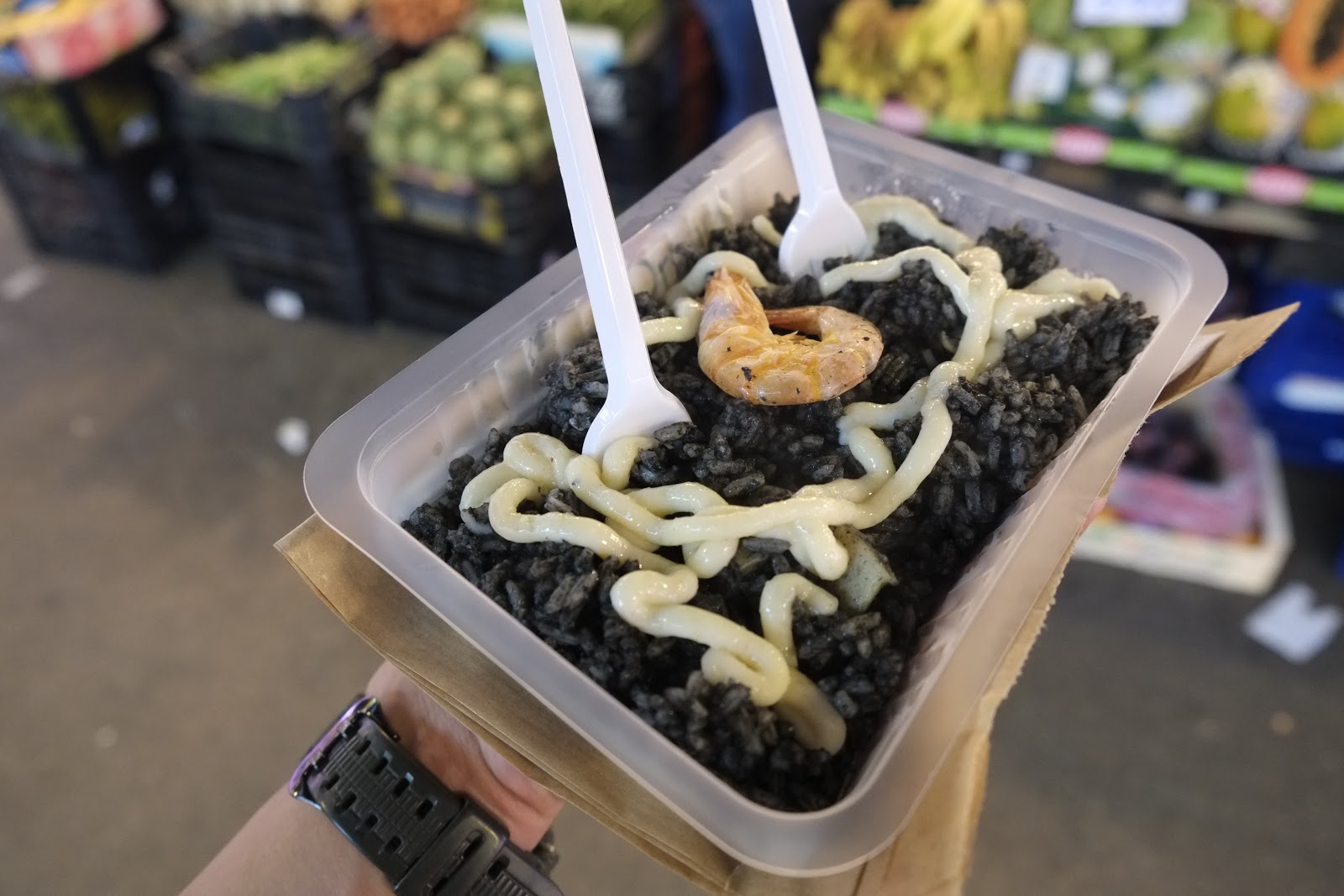
And finally, yes there's the black squid ink. They seem awfully proud of these here. I have no clue if it actually taste anything, or if they simply add it for the colour for added shock value. One common usage is the black squid ink croquette (potato filled fried dumplings). But my favourite is the garlic black squid ink Paella. You can either order a fresh pan of it for yourself (about 14 Euros), or if you are at the market, simply get a serving-size portion for about 6 Euros from one of the already-made giant pans. I swear it will make you fall in love wth black.

Finally, to drink. Well the two consistent choices here are Cava and Vermouth (Vermut). Of course, wine are plenty, and still the most popular choice by far. Cava, as previously mentioned, seems very much alike to any dry sparking wine back home, such as Proseco or Brut. Vermouth would be more of an acquired taste. Previously known to me only as an ingredient in martini (which usually uses more a white, dry vermouth), here it's the sweeter, red version that is more usually drank, often on ice with a slice of orange and an olive. The slightly sweet, tangy, somewhat medicinal taste may surprise some people, but after a few attempts it has become my preferred choice to wash down my Tapas. A glass costs somewhere about 2-3 Euros depending on the restaurant. Traditionally drank as an appetitizer, I like mine towards the end of the meal, as a slight stomach warmer, with just enough sweetness to dampen my appetite, until I turn the next corner, with a brand new exciting Tapas bar awaiting my arrival. And it all begins again.

Catching the fight home tomorrow. Time for some last minute market scrolling. Adios from Spain. Muchas gracias para leyendo. More photos to come on Facebook, eventually.


Eating my way through San Sebastián...


San Sebastián is beautiful. I wasn't expecting much coming here today. For when I got to the bus station it was still drizzling rain, and it seemed my iPhone weather app was destined to failed me again. The rain didn't stop when it arrived. In fact, it intensified. Which gave me all the more excuse to hunt for food right from the get go.

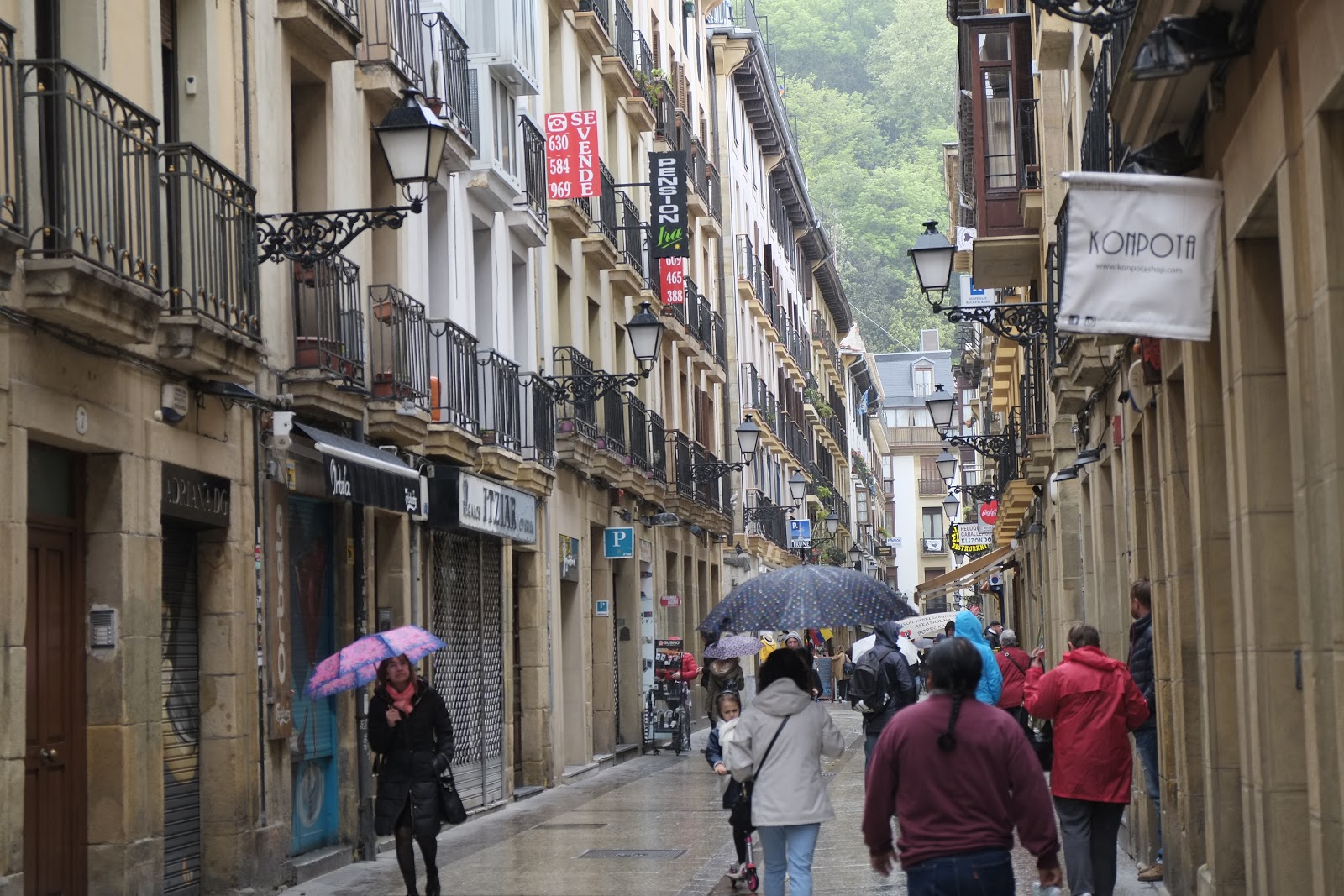
In fact, hunting for food is pretty much the thing to do here. San Sebastián is actually known as a foodie's paradise. From what I've read, it has the highest number of Michelin stars per square meter in the world, and a total of 17 stars to boot. Two of its restaurants are listened in the top 50 in the world in such a little coastal town, and I think one within the top 10.  The old town has probably the highest concentration of Pintxos parlours anywhere, with seemingly one dig trying to out-do another, but each focusing on the one thing they seem best at. Googling for suggestions, I pretty much spent the first part of the rainy afternoon eating my way across town, trying two to three pieces from each places (or five...), and of course washing it down with either a mini serving of beer or Cava. Ganbara, the first bar I went to which had many favorable reviews, was pretty much good at every type of Pintxos that I've seen before. The next one, Bar Txepetxa (I have no idea how to say this either), loves their anchovies, and features it prominently on all their selections, together with fancy stuff like uni (sea urchin) or trout roe or black caviar... The third location, Zeruko, went somewhat insane, and took their art to the next level in esthetics. In fact their tapas look more like carefully crafted dim sum from high end restaurants back home, and often I had no idea what type of food I was selecting until I bite into them and found myself pleasantly surprised. They also grill everything, so once you order what you thought was an amazing looking piece already, they take that, stick in in the boiler, then proceeded to further plate their dish with drizzles of flavoured syrups or basil oil. Theirs were most expensive of course (3 Euros each compared to the other two at 2 Euros), but I couldn't resist and had five when I was already full other places. I wanted more, but I did exercise some self restrain.


In the afternoon, the sun came out. Which means of course everybody had ice cream. And I do mean everyone. I didn't even quite wanted one, but decided I shouldn't be so against the masses that I ordered myself two scoops on a cone (Mango and Tiramisu; I know it was a poor combination). But all the food talk shouldn't take away from how beautiful San Sebastián really is, especially when the weather is great.  The buildings are amazingly rich with aging textures and details, and the streets tidy but festive. Of course, the highlight of the area is the popular La Concha beach, regarded by some as one of the most beautiful urban beaches in the world. Flank between the two overlooking hills, it is in essence of lovely little cove, allowing the harsh Atlantic waves from the Bay of Biscay to mellow out and gently roll in onto the wide patches of fine Atlantic sand. On the other side of the old town, without the protection of the natural cove, the large waves makes it also a big surfing destination for the locals. And every so often, you see fit looking men and women decked in wet suits zip around town, balancing their surf boards on their bicycles, trying to avoid the dense flocks of camera dangling tourists. After all that sight seeing, it was time to feed my tummy again, as I settled onto a sunny patio chair at one of the more popular dessert shops in town, trying to decide which one of the mini pastries I should dive into first to go with my cafe con leche. I have about two more hours to spend in this lovely town before my bus is to go back. I'll have to find some dinner. Which, I'm sure, wouldn't be much of a challenge. If you are ever in the Basque region of Spain, I suggest you come here to take a little peak of this lovely place. One day, maybe two, or a few more if you plan to surf. It'll probably rank as one of the prettier places I've ever seen in my travels.


(Coming here from Bilbao is a simple 1.5 hour bus journey away. The route is served by two carriers. ALSA seems to be the more common cheaper option (about 6 Euros each way but watch out for a few more expensive time slots. Because I chose to go on a National Holiday (Labour Day), there were less buses to choose from, and in order to get a few more hours sleep I went with the other company, PESA, at 12 Euros a piece. Buses were comfortable, modern, and at parts quite scenic. You could also take a slow train there (not part of the Renfe network), but it somehow takes longer and I think about 2.5 hours each way).